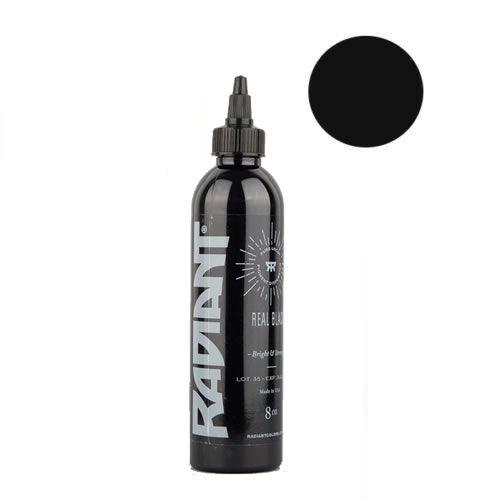
Radiant Real Black Tattoo Ink
- In stock, Ready to ship!
- Backordered, shipping soon
Not every black ink is the same black. The distinction that separates Radiant Colors Real Black from other blacks in their lineup — including Turbo Black, which sits in the same catalogue — comes down to two specifications: the highest concentration of black pigment in the Radiant range, and a formula described as pure enough to guarantee a completely dark tone for a longer period of time, without fading or turning into other shades of black over time. Those two properties together describe a specific black ink character: dense, maximally pigmented, and long-term stable. A black that heals black, stays black, and doesn't develop the blue, green, or grey shift that compromises some blacks at the two and five year marks when the client comes back for new work and you see what your choices healed into. Made in the USA, homogenized, sterilized, vegan.
Maximum Pigment Concentration — What It Means for Each Application
Real Black carries the highest pigment load of any black in the Radiant Colors lineup. The practical consequence of maximum pigment concentration plays out differently depending on the specific application — and Real Black's explicit positioning across four applications (lining, shading, filling, and small details) reflects how that high pigment density is an asset in each context, not just in one.
Lining — Opacity in a Single Pass
For outlining work, maximum pigment concentration means Real Black deposits a fully opaque, solid black from the first pass through a line, regardless of stroke gauge. Consider a bold American traditional piece with a primary outline running at 7–8mm width through the main design elements — the kind of line where the final healed result needs to read as uniformly dense black across its full width, with no lighter centre or patchier areas where the ink deposited less consistently. A black with lower pigment concentration on that gauge often requires a follow-up pass through the same line to fill in the centre where the initial deposit was thinner — the outer edges of the stroke where the needle makes clearest tissue contact are denser than the centre where the skin tension is different. Real Black's maximum concentration puts enough pigment density into the initial pass that the entire line width deposits at consistent opacity. The healed result has no centre-lightness issue — the line reads as evenly solid from edge to edge.
The same principle applies at fine gauge. A 1RL or 3RL outlining needle deposits a very narrow column of ink. At lower pigment concentrations, that narrow column may not contain enough pigment particles to produce a fully opaque fine line at the healed stage — the line looks correct in the fresh tattoo but heals to dark grey rather than true black. Maximum pigment density means even the smallest volume deposited through a fine needle contains enough pigment to heal as solid black. For fine line portrait artists and ornamental tattooers whose entire aesthetic depends on lines reading as definitively black rather than dark grey, this is not a subtle quality variable.
Shading — Grey Wash Range and Tonal Depth
For black and grey shading, maximum concentration is the starting point that determines the full tonal range available from a single ink. The way black and grey work actually operates is through dilution: undiluted black for the deepest shadows, progressively diluted grey washes for the mid-tones and lighter values, with the undiluted ink reserved for the darkest passages that anchor the value structure of the piece.
Here's the concrete difference Real Black's maximum pigment load makes in grey wash work: imagine building a black and grey sleeve portrait. The deepest shadow areas — inside a cast shadow under the jaw, within the deep hollow of an eye socket, the darkest passage in a hair mass — need to be as close to true black as possible to ground the visual weight of the piece. A 1:1 dilution (equal parts ink to water) produces a rich mid-grey for the transitional shadow areas across the cheek and temple. A 1:3 dilution produces a lighter grey for the half-shadow tones. A 1:5 or 1:6 dilution produces the lightest near-skin tones in the highlight-adjacent areas.
With a lower-pigment-concentration black, each dilution step produces a weaker result — the 1:3 dilution reads as very light, the 1:5 is nearly invisible, and the artist's usable grey range compresses into a narrower portion of the value scale. With Real Black's maximum concentration, each dilution step still has enough pigment density to produce a clearly readable, distinct tonal value. The 1:5 dilution reads as genuine light grey rather than barely tinted water. The full tonal range from the deepest black to the lightest wash is workable across its entire span — which is what a black and grey portrait artist needs to render skin, hair, fabric, and metal across an arm's worth of canvas with the complete value vocabulary the subject requires.
Filling — Where Maximum Concentration Is Non-Negotiable
Filling is the application where pigment concentration matters most and where Real Black's maximum density provides the clearest functional advantage. A fill — a solid black area covering significant skin coverage, like the background of a Japanese traditional piece, a blackout sleeve, a tribal design, or a large neo-traditional shape — needs to heal as uniformly dense, evenly saturated black across its entire area. This is technically the most demanding black ink application because any inconsistency in pigment density becomes visible at the healed stage as patchy lighter areas within what should be a solid field.
Consider a client getting a large black background fill behind a detailed koi fish sleeve — an area that might cover 400–500 square centimetres of skin across the outer arm. The artist is making multiple passes across the same area, building saturation layer by layer. Each pass with a lower-concentration black adds pigment, but if the concentration per pass is insufficient, the artist ends up making six or seven passes across the same skin area to achieve the saturation that Real Black achieves in four. Those additional passes are additional trauma to the same tissue — and heavily worked skin loses pigment more aggressively during healing because the healing process has more damage to repair. The result with an underpowered fill ink is often a healed background that looks solid black in areas that were overworked and slightly lighter in areas where the artist ran out of tolerance and had to stop. Real Black's maximum concentration lets the fill build to target saturation in fewer passes — the tissue comes through healing in better condition, and the healed result is more uniformly solid across the full fill area.
The same principle applies on a smaller scale: a solid black shape in a neo-traditional piece — a filled geometric background element, a solid black bird silhouette, a filled banner — needs to read as dense and even rather than showing texture or lighter patches within what's meant to be a solid form. Maximum pigment concentration is what prevents those fill areas from reading as slightly uneven or watercolour-textured when the intent was solid black.
Small Details — Fine Deposit at Minimum Gauge
In fine detail work — micro-textures in hyperrealistic skin rendering, the fine hairs in an animal portrait, the serif endings on a lettering piece — Real Black's dense pigment ensures that even the smallest volume deposited through the finest needle gauge contains enough pigment to heal as a defined, visible mark rather than a faint suggestion of one. This is the same fine-gauge opacity argument as in lining, but applied to the smallest marks rather than to continuous lines: every individual mark, no matter how small, heals as distinctly present because the pigment density is sufficient even at that minimal deposit volume.
A concrete example: in a hyperrealistic dog portrait, the individual hairs in the fur texture around the muzzle are rendered as short, fine, closely spaced strokes using a single needle at the lowest voltage setting that produces clean penetration. These marks need to heal as individually distinguishable — each one a defined dark line — rather than merging into a grey texture field. Lower pigment concentration means each mark may not have enough pigment to survive the healing process with full opacity, and the fine detail that the artist carefully built in the session heals into a slightly blurred texture mass. Real Black's density ensures each fine mark has enough pigment volume to hold through healing as a distinct, individually visible stroke.
Long-Term Colour Stability — Why "Real" Black Means Black That Stays Black
The claim that distinguishes Real Black within the Radiant lineup is the one that matters most over the long arc of a tattoo's life: a formula pure enough to guarantee a completely dark tone for a longer period of time, without fading or turning into other shades of black over time. Understanding why this is a meaningful claim — rather than a generic marketing statement — requires knowing what actually happens to black tattoo inks that don't hold their character over time.
Black tattoo ink that shifts colour at the healed or aged stage typically does so because the formula contains multiple pigment components that degrade or fade at different rates. The most common failure modes:
- Blue shift: Some black inks contain blue pigment components — sometimes deliberately to produce a "warm" or "rich" black, sometimes as an artefact of the pigment base. As the ink ages in the skin, the lighter components fade faster than the carbon or densely pigmented components, leaving the residual pigment with a distinctly blue character. This is the classic "blue tattoo" effect — work that was clearly black at six months and clearly blue-grey at three years. The client whose fresh pieces look great but whose older work has gone distinctly blue is most likely working with a black ink that had blue components in the formula. Real Black's "pure formula" claim means the pigment base is clean black without these additional chromatic components — there's nothing to separate out and shift the remaining colour.
- Green or purple shift: Less common but visible in certain older or lower-quality black formulations. Certain organic pigment components that contribute to a black ink's richness or depth can break down into residual hues that read as green or purple at the aged stage. Again, the cause is multiple-component formula where components degrade at different rates. A pure, single-component or tightly controlled-component black formula eliminates these failure modes at the source.
- Grey fade without colour shift: All tattoos fade over time — this is expected and normal. The distinction Real Black makes is not "won't fade" (no ink makes that claim honestly) but "won't turn into other shades of black over time." A black that fades cleanly — becoming lighter while remaining black — is a fundamentally different aged result than a black that fades to blue or green. A faded black can be refreshed with a touch-up and return to solid black. A blue-shifted black needs colour correction before fresh black can be applied on top without the underlying blue affecting the overall tone.
For the working artist, Real Black's long-term stability claim means clients whose work was done with Real Black will come back for touch-ups and new work showing healed pieces that have aged correctly — dark, still black, ready for a clean refresh rather than requiring correction work first. This is a cumulative professional advantage: over years of practice, your portfolio of healed work reflects the actual quality of your technique rather than being compromised by the colour behaviour of inferior inks.
Real Black vs. Turbo Black — Choosing Between Two Radiant Blacks in the MTS Catalogue
Both Real Black and Turbo Black are homogenized, sterilized, Made in the USA Radiant Colors blacks. The practical question is which one belongs in a given artist's setup — or whether both do. Here is the honest, specific differentiation:
Turbo Black is formulated primarily for outlining and fast detail work. Its defining characteristic is the "turbo" combination of high pigment and specifically low viscosity — the fast-flow character that lets the ink move through fine needle channels at outlining speed without drag. Its positioning is lining-first, with shading and detail as secondary applications. Artists who do a lot of high-speed outlining on bold traditional, neo-traditional, or lettering work will find Turbo Black's flow character serves their primary technique most naturally.
Real Black carries the highest pigment concentration in the Radiant lineup — higher than Turbo Black — with a formulation centred on maximum density, long-term colour stability, and versatility across the full range including filling. Its flow is still excellent (Radiant's homogenized base ensures that across their line), but the primary differentiation is pigment load and permanence rather than speed of flow. Artists who do significant fill work, blackwork, or black and grey work where they need maximum tonal depth and long-term stability will find Real Black the more appropriate primary black.
The common working combination: Turbo Black in the outlining tube for lining passes, Real Black in the shading setup for grey washes and fill work. These are not interchangeable — they are complementary tools with overlapping but non-identical optimal applications. Artists who have both in their station and choose between them session-to-session based on the specific demands of the piece being worked are using them exactly as the lineup's differentiation was intended.
Technical Specifications
- Colour: Black
- Pigment concentration: Highest in the Radiant Colors black range
- Applications: Lining, shading, filling, small details
- Long-term stability: Formulated to remain true black without colour shift over time
- Formula: Pure uncut homogenized pigments
- Sterilized: Yes — every batch
- Vegan: Yes
- Origin: Made in the USA
Why Artists Use Radiant Colors Real Black
- Highest pigment concentration in the Radiant range — maximum density for fully opaque lining in a single pass, rich grey wash range from deep black through light tones, efficient fill work with fewer passes and less tissue trauma, fine detail marks that hold through healing
- Long-term colour stability — no shift to blue, green, or grey — pure formula without the multi-component structure that causes black inks to change character at the two and five year marks; your healed work stays black rather than becoming a correction problem
- Full four-application versatility — lining, shading, filling, and fine detail; the only Radiant black that explicitly covers all four rather than specialising in two or three
- Homogenized pigments for consistency — uniform particle size and distribution; consistent flow and deposit across the full session without settling or clogging
- Vegan, sterilized, Made in the USA
Radiant Colors Real Black is the maximum-density black in the Radiant lineup — the one for artists who prioritise pigment load, long-term stability, and versatility across every black ink application over the fast-flow specialist character of Turbo Black. If your work includes significant fill areas, blackwork backgrounds, or black and grey realism where tonal range and long-term colour accuracy are the primary black ink requirements, Real Black is the Radiant black that was formulated to meet those specific demands.
For Canada shipping is free on orders over $250CAD*.
Canada:
- If you are located in the GTA, Newmarket, Hamilton, Burlington, Whitby, or Oshawa you can choose Local Delivery.
- For orders over $250 in the GTA: Same-day delivery is available if orders are placed before 12 pm.
- Next-day delivery for orders in Newmarket, Hamilton, Burlington, Whitby, and Oshawa.
- You also have the Standard option: This is also free for orders over $250, where we select the best carrier to deliver your order promptly and reliably.
For paid options, you may choose any shipping carrier and delivery type at checkout.
* Free shipping applies to standard-sized orders. Bulky and heavy products may incur additional shipping charges regardless of order total.
* TATSoul furniture items and other oversized products excluded from free shipping and are always subject to shipping charges, regardless of order value.
Return Policy
Thank you for considering our tattoo supplies for your business. We take pride in providing high-quality products to our customers. Below is our final sale policy for tattoo supplies:
All sales are final. We do not accept returns or exchanges, except in the case of defective or damaged products. If you receive a defective or damaged product, please contact us within 7 days of receiving the product to initiate a return or exchange. To be eligible for a return or exchange, the product must be in its original packaging and unused.
If a return, for any specific reason, is approved by management, a 20% restocking fee will be applied to the order.
We do not provide refunds or credits for any products that have been opened, used, or altered in any way. Please ensure that you carefully review your order before finalizing your purchase. If you have any questions or concerns about a product, please contact us prior to making your purchase.
In the unlikely event that we are unable to fulfill your order, we will provide a full refund for the unavailable product(s). We reserve the right to cancel any order for any reason and will provide a full refund in such cases.
We stand behind the quality of our products and take pride in ensuring that our customers are satisfied with their purchases. If you have any questions or concerns about our final sale policy or any of our products, please do not hesitate to contact us. We are here to help and want to ensure that your experience with our company is a positive one.
Obituary orders online
We strive to ensure your tattoo supplies arrive exactly as you ordered. If, however, you believe there's an issue with your order (wrong item, etc.), please notify us within 7 days of placing your order.
Unfortunately, claims reported after this timeframe will not be accepted. This allows us to investigate discrepancies efficiently and ensure customer satisfaction.
For prompt resolution, please contact us at info@mapletattoosupply.com with details of the issue and your order number. We appreciate your understanding!
Delivery
If customer does not pick up/receive order, shipping company will be reached out to. If it is the clients fault they are responsible for the cost of the return label, shipping fee & 20% restocking fee.
If it is Maple Tattoo Supply’s fault and the client wants a refund, we will give the refund.
Local pick up- customer has 4 weeks to pick up order, after 2 weeks we will call them and remind them of the order that is ready for pickup and let them know they have 1 more week to pick up their order or it will be cancelled and there will be a 20% restocking fee.
Unapproved Return Policy:
We do not accept returns without prior approval. Before shipping any item back, you must contact us to obtain authorization for your return. Only after receiving our approval will we process the return request. You must initiate a return or exchange within 7 days of receiving the product.
To be eligible for a return or exchange, the product must be in its original packaging and unused.
If you have already shipped the order, you have 15 days from the delivery date to contact us regarding the pickup of your unapproved return. If you fail to do so within this period, the order will be disposed of with no possibility of a refund, exchange, or retrieval.
To initiate a return request, please contact our customer support team at info@mapletattoosupply.com.
We appreciate your understanding and cooperation.