




OUR REVIEWS
Trusted for 15+ Years by 20,000+ Happy Customers!


Trusted for 15+ Years by 20,000+ Happy Customers!
PMU cartridges are built for facial skin — thinner, more reactive, and less forgiving than body skin. The differences that matter in practice: finer needle taper for cleaner entry with less trauma, tighter grouping tolerances so needle scatter doesn't widen strokes beyond what the artist intends, and configurations designed for the shallow implant depth PMU procedures require. A standard body tattoo cartridge goes deeper and moves more ink per pass — which is exactly wrong for brow, lip, and eyeliner work where saturation needs to build gradually across multiple passes. Kwadron separates its Optima PMU line from its standard body range for this reason. Using a body cartridge for PMU work isn't impossible but the margin for error is smaller and the healing result shows it.
The numbers and letters describe the needle diameter, count, grouping, and taper. Breaking down a typical configuration like 0.30/5RL: 0.30 is the needle diameter in millimetres — standard for most PMU work; 5 is the needle count — five needles in the grouping; RL is Round Liner — needles arranged in a tight circular pattern for line work. The LT suffix stands for Long Taper — needles that taper to a finer point over a longer distance, which produces cleaner entry into the skin with less trauma and is preferred for fine PMU line work. T on its own indicates standard taper. For PMU specifically, Long Taper configurations are the default choice for most brow and eyeliner procedures. Higher needle counts like 9RL or 14RL move more pigment per pass and are used for shading and powder work rather than line work.
Kwadron Optima PMU is the most consistently used cartridge line for professional brow work — the combination of Long Taper configurations, tight manufacturing tolerances, and PMU-specific needle groupings makes it the default in most high-volume PMU studios. Cheyenne Safety Cartridges are the second most common choice, particularly in studios where hygiene compliance and ink backflow prevention are a priority — the membrane mechanism is a practical advantage in a studio environment. Mast Pro is a reliable mid-range option for artists who want consistent performance at a lower price point. The right answer also depends on the machine — cartridge and machine compatibility matters, and some artists choose their cartridge brand based on what runs cleanest in their specific device.
The membrane is a physical barrier inside the cartridge that prevents ink and biological fluid from travelling back up the needle into the machine grip and body. Without it, contaminated fluid can reach parts of the machine that are difficult or impossible to sterilise between clients. Cheyenne's Safety Cartridge system was built around this mechanism and it's the primary reason the brand became standard in European PMU studios where hygiene regulations are strict. For studios operating in regulated environments or simply running a higher standard of cross-contamination control, the membrane is a functional advantage over standard cartridges without it. It also extends machine lifespan by keeping the grip and internal components cleaner over time.
These are grouping configurations — how the needles are arranged and what kind of mark they make in the skin. Round Liner needles are arranged in a tight circle and come to a single point — designed for precise line work, hairstrokes in brows, and eyeliner. Round Shader needles are arranged in a slightly looser circle — designed for shading, soft fill, and powder brow work where you need a diffused edge rather than a clean line. Magnum needles are arranged in two rows in a flat pattern — designed for covering larger areas efficiently, used in ombre work and body shading. Soft Edge Magnum is the same flat arrangement but with the outer needles curved slightly — it produces a softer edge on the shaded area and is the preferred choice for blended ombre work where hard edges are a problem. For most PMU brow work: Round Liner for hairstrokes and definition, Round Shader or Soft Edge Magnum for powder and ombre fill.
Sample boxes contain multiple cartridge configurations in smaller quantities — usually assorted needle counts or configurations within one brand's range. Matrix Genesis offers Mixed, Liner, Realism, and Soft Edge Magnum sample boxes; Kwadron has a TOP 10 Pack and Magnum Essential Pack. They're useful in two situations: when you're evaluating a new brand before committing to full box quantities, and when you're expanding your configuration library and want to test how specific needle counts perform in your technique before stocking them. For established artists with a fixed workflow, sample boxes are less relevant — you already know what you run. For artists still refining their setup or trialling a new machine pairing, a sample box is a significantly cheaper way to find out what works than buying full boxes of three or four configurations.
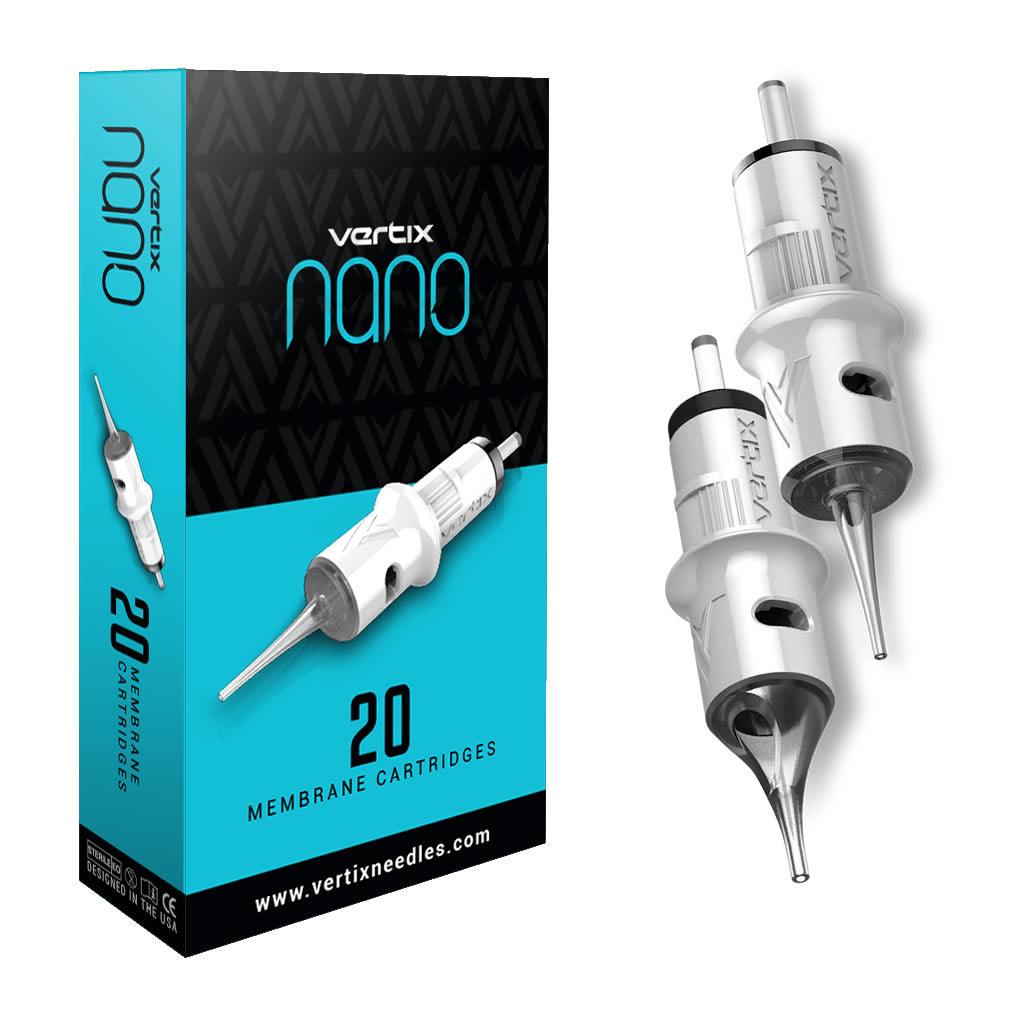
Procedure and technique together drive the decision — there's no single correct answer, but there are clear starting points. For microblading-style hairstrokes: 1RL or 3RL with Long Taper. For nano brows and fine detail: Vertix Nano configurations or 1RL Long Taper at the smallest available diameter. For powder brows and ombre: Round Shader or Soft Edge Magnum in 5 to 9 count depending on how quickly you want to build saturation. For lip blush: Round Shader 5 or 7, sometimes Round Liner for lip border definition. For permanent eyeliner: 1RL or 3RL Long Taper for the lash line, Round Shader for any shading or diffused liner styles. For SMP: dedicated PMU configurations at small diameters — the dot needs to stay small and sharp through the heal. Machine speed, hand speed, and skin type all shift these starting points, which is why experienced artists develop their own preferred configuration list over time rather than following a fixed chart.
Join the Maple Tattoo Community
Exclusive deals, pro tips, and new products. Trusted by Canadian artists since 2018.